UEFA Euro 2016, hosted by France, was a tournament that defied expectation and rewrote the script for European football. It was a championship less defined by the predictable dominance of traditional powerhouses and more by the sheer tenacity, defensive grit, and fairytale narratives of the underdogs. From the expansion of the field to the emotional final, the summer of 2016 delivered a unique blend of tactical warfare and historic upheaval that cemented its place as one of the most memorable European Championships of the modern era.
The New Format and the Rise of the Underdogs
One of the most significant features of Euro 2016 was the expansion of the final tournament from 16 to 24 teams. Critics initially feared this change would dilute the quality of the group stage, but instead, it injected a fresh dose of unpredictability and allowed smaller nations to showcase their capabilities on the continental stage. This new format, which allowed four of the six third-placed teams to qualify for the knockout rounds, created an environment where cautious, defensive strategy was rewarded.
The tactical consequence was immediate: teams recognized that securing a single win and a draw might be enough to survive the group stage, leading many lesser-fancied sides to prioritize defensive solidity over attacking flair.
The Cinderella Stories that Shook the Tournament
This defensive focus paved the way for the tournament’s defining surprise: the extraordinary run of the underdogs.
- Iceland’s Thunderclap: Making their debut in a major tournament, Iceland, a nation of just over 330,000 people, captured the world’s imagination. Their organized defense, tireless running, and iconic “Viking Clap” culminated in a historic 2-1 victory over England in the Round of 16—a result that sent shockwaves through the football establishment and remains one of the greatest upsets in Euro history.
- Wales’s Dragon Roar: Led by the brilliance of Gareth Bale and the astute management of Chris Coleman, Wales delivered a performance of courage and quality. They topped their group and, in a thrilling quarter-final, dispatched a highly-rated Belgium team 3-1 with an exhibition of powerful, attacking football. Their journey to the semi-finals—their first ever major tournament semi-final—was a testament to national pride and team unity.
These narratives proved that the expanded format successfully lowered the entry barrier, allowing grit and tactical discipline to triumph over pedigree and star-studded rosters.
Tactical Battles and the Struggle for Goals
Despite the exciting upsets, the tournament was also characterize by a noticeable lack of high-scoring thrillers, particularly in the later stages. The defensive tactical masters often prevailed:
- Italy’s Defensive Genius: Under coach Antonio Conte, a seemingly modest Italian squad executed brilliant tactical game plans, utilizing a fierce three-man defense and intense pressing to eliminate favorites like Spain (in the Round of 16) before narrowly losing to Germany on penalties in a historic quarter-final that went 18 rounds.
- The Goalkeeper Show: The lack of open play goals often put the spotlight on goalkeepers. Performances by the likes of Italy’s Gianluigi Buffon and Germany’s Manuel Neuer demonstrated why the modern shot-stopper is perhaps the most important defensive player.
The collective cautiousness meant that set pieces and moments of individual brilliance, rather than sustained attacking dominance, often proved decisive.
Portugal’s Unlikely Triumph
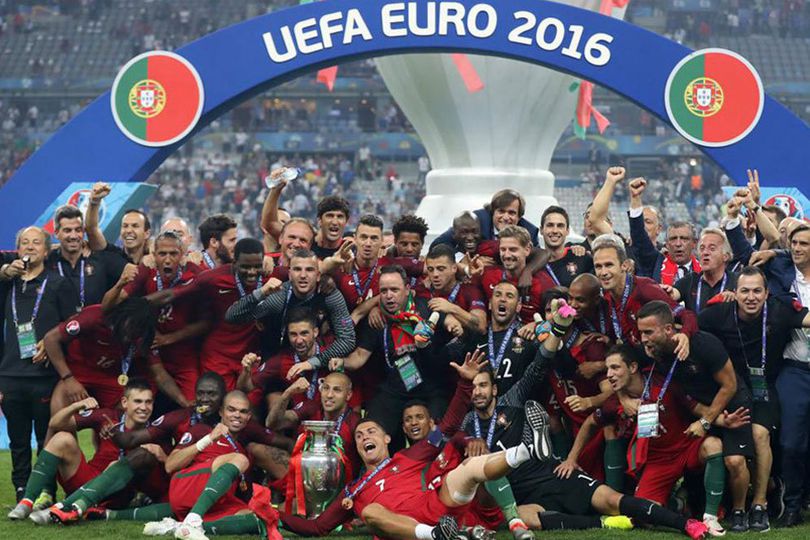
The final chapters of Euro 2016 belonged to Portugal, a team that earned their title through resilience and persistence, rather than dazzling dominance. Their path to glory was highly unusual:
- Group Stage Draw: Portugal famously failed to win a single game in the group stage, drawing all three matches and qualifying only as one of the best third-placed teams.
- Grinding Through the Knockouts: They won just one match inside 90 minutes (the semi-final against Wales). Their victories over Croatia and Poland required extra time and a penalty shootout, respectively.
The Final: A Test of Character
The final against hosts France was a dramatic affair, defined by the early injury to Portuguese talisman Cristiano Ronaldo. His emotional departure could have signaled defeat, but instead, it galvanized the team. Portugal adopted an even deeper defensive posture, relying on goalkeeper Rui Patrício’s heroics and the collective spirit preached by coach Fernando Santos.
The moment of victory arrived in the 109th minute of extra time when substitute Éder, a player previously ridiculed by fans, struck a low, powerful shot that secured a shocking 1-0 victory. It was a victory forged in adversity, grit, and collective belief—a fitting conclusion to a tournament dominated by the unexpected.
Conclusion: A Legacy of Resilience
UEFA Euro 2016 will be remembered as the Summer of Surprises and the tournament that proved the value of defensive structure and teamwork. It was a championship that celebrated the arrival of new nations like Iceland and Wales, witnessed tactical masterclasses from Italy, and crowned a champion, Portugal, whose defining characteristic was their incredible resilience under pressure. The legacy of Euro 2016 is simple: in modern European football, pedigree counts for little when faced with tactical discipline and the unbreakable spirit of an underdog.